The best books are those that tell you what you already know, but didn’t know that you knew.—Neel Burton, psychiatrist and philosopher, University of Oxford
There is more to being human than the absence of disorder.
We live in an era of rapid change and growing uncertainty. Many of the structures that once gave us identity, meaning, and direction are being upended. Today more than ever, we must answer life’s great questions for ourselves. How should we live, love, work, suffer, and die?
I’ve been searching for answers across psychology and philosophy, literature and history, mythology and ancient wisdom—and sometimes in less obvious places, like a bottle of wine. The deepest truths often emerge where disciplines meet.
Taken together, my books amount to an education in how to think, how to live, and how not to waste your life.
I hope you find something here that speaks to you.
If you’re new here, these are good places to begin.
Harvest at the Abbaye de Lérins, on an island opposite Cannes, c. 1900.
By Dr Neel Burton — Psychiatrist, philosopher, and wine writer; Fellow of Green Templeton College, University of Oxford; author of over twenty books.
Recently, I decided to get in touch with a childhood friend. We hadn’t spoken in twenty-five years.
He wasn’t just any childhood friend. We were born on the same day, in the same town, one hour apart. We used to joke that we were twins from different mothers.
In the intervening years, he had become a Trappist monk: a strict kind of monk who practises deep silence and speaks only when necessary. I write him long, flowing letters; he replies laconically, but touchingly.
His life is austere. Every morning, he wakes up at 3:30 to pray. And yet I find myself envying something in it: its simplicity, its mindfulness, and its constant, if mostly silent, companionship.
My twin brother got me thinking about the monastic life. As I researched, I found something most astonishing: If you are poor and uneducated, you may be able to enjoy the same health outcomes and life expectancy as the richest and most educated… simply by becoming a monk or nun.
This remarkable fact ought to be better known, and probably would be if it did not sit so uneasily with our cut-throat consumerist society.
The Price of Inequality
A major American study found that, at age 40, the richest 1 per cent of men could expect to live 14.8 years longer than the poorest 1 per cent. For women, the gap was 10.6 years.
The inequality is not just in how long people live, but how well. In England, people born in the most deprived areas in 2018-20 could expect nearly twenty fewer years in good health than those born in the least deprived areas: 19.3 fewer years for women, and 18.6 for men.
In a monastery, these inequalities simply vanish. A 2025 study followed 2,421 German Catholic monks born between 1840 and 1959. The researchers used the order’s titles “brother” and “padre” as indicators of socioeconomic status, with brothers often engaged in manual labour and the better-educated padres holding senior administrative posts. Across the different birth cohorts, they found no statistically significant survival difference between the two groups.
The contrast is all the more striking because monks appear not only to escape the inequality between rich and poor, but also to live unusually long lives. A study of Bavarian religious communities found that young adult monks could expect to live up to four years longer than other men. A Korean study analysing newspaper death notices across occupational groups between 1963 and 2010 found that clergy, including Buddhist monks, had the highest reported average age at death, at about 80.
Cloistered life reduces inequality not just between rich and poor, but also between men and women. A girl born in America in 2024 could expect to live 4.9 years longer than her male counterpart. By contrast, a study of Bavarian religious communities found that nuns’ life expectancy exceeded monks’ by only about one year.
A Different Way to Live
What might explain this all-round levelling effect? In a monastery, many of the things that make life better and safer are shared. Monks eat together, live under the same roof, follow a common routine, and receive the same care.
The monastery also offers something harder to measure: a place within a community, useful work, and a strong sense of purpose. Its members have a role and a status, but little of the competition that governs life outside. They have peace and quiet without being alone. Even death belongs to a shared—and continuing—story.
The implication that you can “win at life” simply by stepping out of the rat race is, of course, deeply disturbing. Our society assumes that income and education represent genuine advantages. But the monastery suggests that they matter partly because the world outside is insecure, competitive, and unequal. Once people share the same housing, food, healthcare, community, and purpose, much of the advantage of wealth and education simply disappears.
I think of my friend waking up at 3:30 to pray and chant. His life is austere, but far from empty. Perhaps that is what I envy: not the silence alone, but the sense that a life can be rich—in fact, far richer—without being organised around acquisition, comparison, and the fear of falling behind.
Old Vines, Mountain Wines, and Spain’s Garnacha Revival
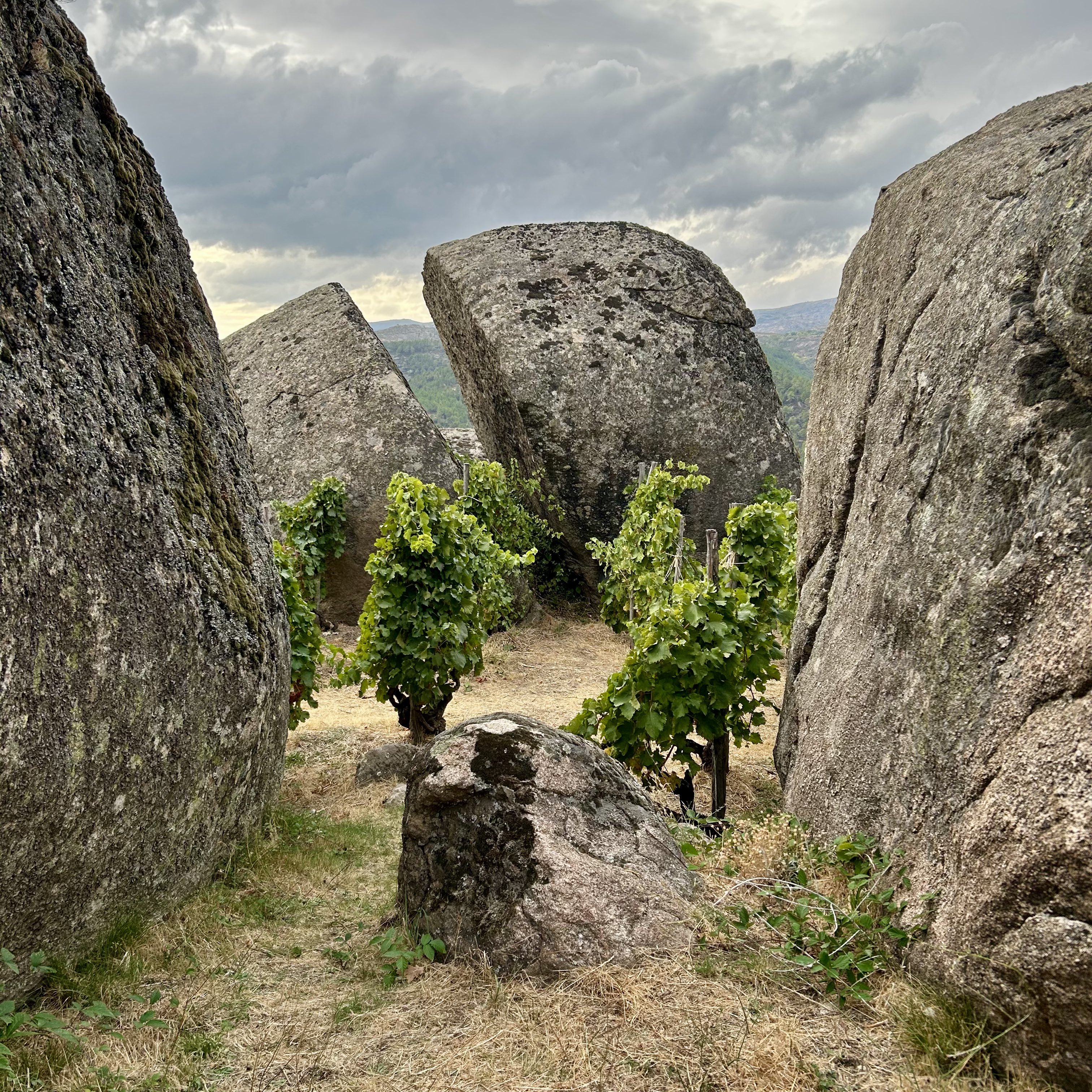
Comando G’s famous Rumbo al Norte vineyard.
By Dr Neel Burton — Psychiatrist, philosopher, and wine writer; Fellow of Green Templeton College, University of Oxford; author of over twenty books.
In the Sierra de Gredos, west of Madrid, once-neglected old bush vines are yielding some of Spain’s most compelling wines: pale, elegant Garnacha and complex, characterful whites from Albillo Real. I have a bottle of the Garnacha open beside me as I write.
The vineyards lie across three main valleys: the Alberche in the centre, the Alto Alberche to the north, and the Tiétar to the south. Both the Alberche and the Tiétar flow into the Tagus. Enormous granite boulders punctuate the landscape; Comando G’s famous Rumbo al Norte looks more like a sculpture park than a vineyard, more like Easter Island than Spain. San Martín de Valdeiglesias, Cebreros, and El Tiemblo are about an hour away from Madrid. A further hour’s drive takes you into the Alto Alberche, close to the fortress city of Ávila.
Map of the Sierra de Gredos wine region.
Near El Tiemblo stand four pre-Roman granite bulls, the Bulls of Guisando. In Don Quixote, the rival Knight of the Mirrors boasts of having lifted them at his ladylove’s command. The region’s vineyards faced a less fanciful trial. The railway brought competing wines from Valdepeñas to Madrid, while Gredos’s steep, often terraced plots were costly to work and difficult to mechanise. Rural depopulation compounded the decline, leaving many vineyards abandoned. The modern revival gathered momentum with pioneers such as Telmo Rodríguez and Pablo Eguzkiza, who bought their first Gredos vineyard in 1999. Comando G, established in 2008, brought the region to international prominence.
The Bulls of Guisando
Above the granitic bedrock, coarse sands derived from weathered granite range from a few centimetres to several metres in depth. There are also pockets of friable schist, notably around El Tiemblo. Whereas the granitic soils tend to yield fragrant, silky Garnacha, the schistous soils are associated with greater firmness and depth.
The combination of old bush vines, granite, and schist recalls another of my favourite wine regions: South Africa’s Swartland. In both places, a new generation of winegrowers recognised that vines valued chiefly for bulk production could yield wines of extraordinary distinction. If you already love Swartland, you will love Gredos.
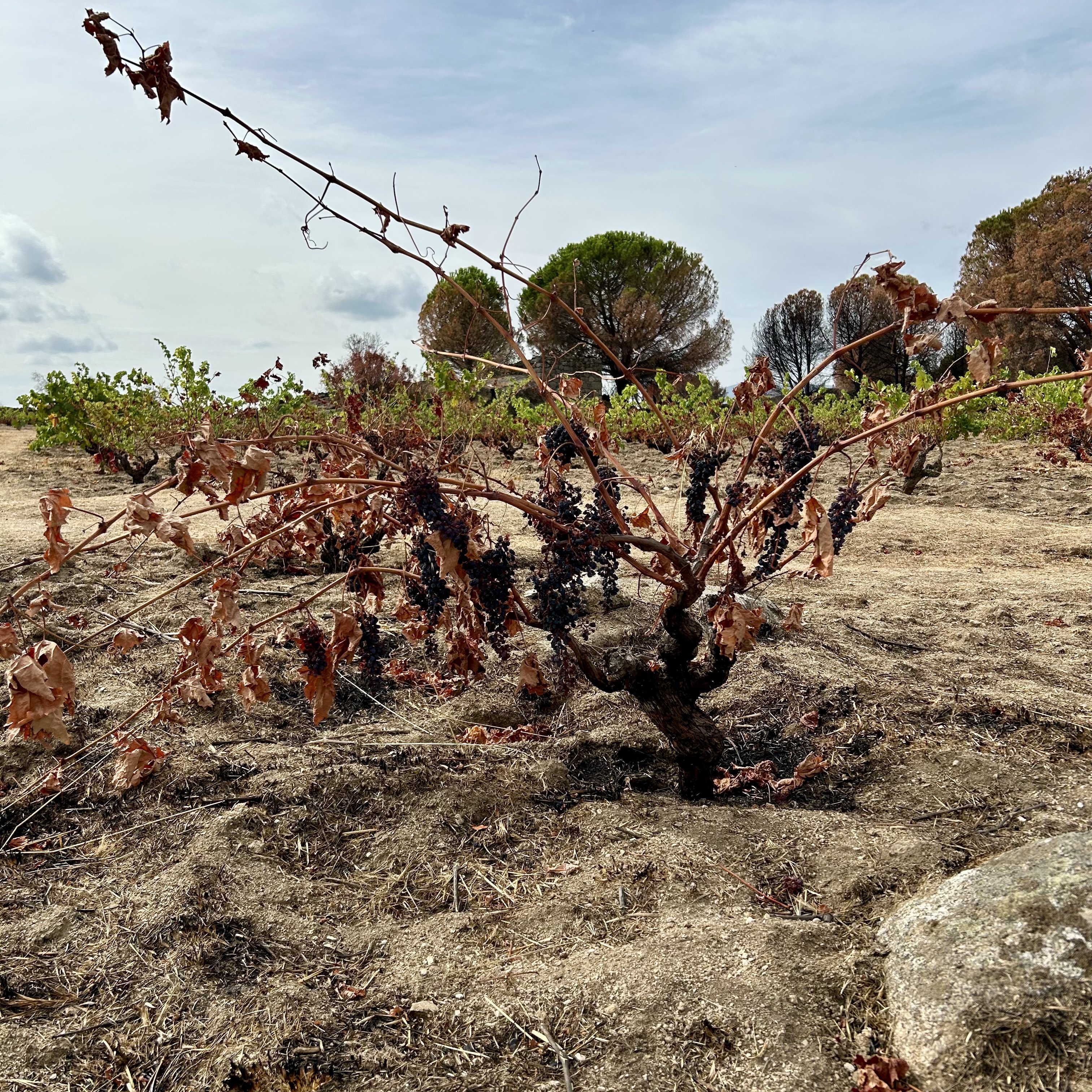
Gredos has hot, dry summers and cold, wetter winters, with snow at higher elevations. In 2026, Spain suffered the worst wildfires in its history. When I visited the region that September, several producers reported losing two or three hectares of vines—a considerable loss for estates with only a dozen or so hectares, and one made harder, and sadder, by the age of the vines.
Summer 2026: Century-old vines reduced to ash.
In total, there are some 4,000ha of vines. Vineyards tend to be small and scattered, with many abandoned plots. Some lie above 1,000 metres, some even above 1,200, where high diurnal temperature variation helps preserve freshness and develop aromatic complexity. Yields are low, often below 30hl/ha. The dry summers and strong winds favour organic viticulture. As one winemaker told me, “It’s hard to make bad wine here.”
Despite its reputation, Gredos has no eponymous appellation—in part because the wine region straddles the provinces of Madrid, Toledo, and Ávila, each in a different autonomous community. Wines carrying a geographical designation appear under Cebreros, Méntrida, or Vinos de Madrid, or the broader Vino de la Tierra de Castilla y León. Still, qualifying wines within Cebreros may carry ‘Sierra de Gredos’ on the label.
Grenache Noir (Garnacha Tinta) accounts for some four-fifths of plantings. I found two broad styles: pale, ethereal wines driven by acidity, and the soupier kind of Grenache best left to others. The finest examples can recall the best of Burgundy, with their superfine tannins and notes of rosehip, lavender, violets, incense, thyme, and fennel—often reflecting the aromatic plants growing among the vines.
Albillo Real—not to be confused with Albillo Mayor—was once sold as a delectable table grape, but in Gredos yields some of Spain’s most serious and intriguing white wines. Its low, sprawling bush vines ripen early, and growers prize its affinity for warmth and sunshine, whereas Grenache often benefits from cooler, north-facing slopes. The examples I tasted were complex and full-bodied, with notes of honeycomb, jasmine, citrus pith, and herbs, and a saline finish. Yet in 2025, only around 50 hectares of Albillo Real were registered within the Cebreros appellation.
Barrel tasting at Bernabeleva, in San Martín de Valdeiglesias. Arroyo del Tórtolas is Juan Diez’s favourite wine, and it was mine too.
Favourite producers in Gredos include 4 Monos, Bernabeleva, Comando G, Daniel Ramos, Las Moradas, and Sotomanrique. Daniel Ramos makes his wines as naturally as possible and releases them over several years. At Las Moradas, Isabel Galindo has been making wine since 2003 and has perfected her art. My favourites at 4 Monos and Bernabeleva were the single-vineyard Molino Quemado and Arroyo del Tórtolas respectively. Sotomanrique in particular struck me as very good value for money, especially in their three single vineyard wines.
If you ever visit beautiful Gredos, the tiny Hotel Labranza in San Martín is a traditional casa de labranza (farmhouse) built in the eighteenth century—with such a soundscape, and such breezes, that I struggled to get out of bed in the mornings.
Why Intelligence and Critical Thinking Are Not Enough
Théodore Géricault, La Monomane de l’envie—or what three hours of scrolling can do to you.
By Dr Neel Burton — Psychiatrist, philosopher, and wine writer; Fellow of Green Templeton College, University of Oxford; author of over twenty books.
We have more access to information than ever before, but the information that we see is that which is most likely to grab and hold our attention. We might wonder whether this is knowledge at all—or, in fact, the opposite of knowledge.
Fake news is not new. A year after the Battle of Actium in 31 BCE, Cleopatra sent word to Mark Antony that she had killed herself. Believing the report, Antony stabbed himself—only to discover that Cleopatra was still alive. What’s new is the speed and precision with which a falsehood can be targeted at millions.
How Manipulation Works
Manipulation seldom consists in an outright lie. Rather, it consists in controlling the picture. Each statement may be true, while the picture created by those selected statements is profoundly false.
Imagine two reporters covering the same protest. One focuses on the peaceful marchers; the other, the broken windows. One interviews the protesters; the other, the shopkeepers. Both reports may be factually accurate, and yet leave us with a misleading picture of what happened. That’s why fact-checking, though important, can only take us so far. Facts need context, proportion, and balance.
Manipulation works because we are biased. We tend to notice the information that confirms our existing beliefs while ignoring what challenges them. The first person to manipulate me is not a politician or an algorithm, but myself.
Engagement algorithms are designed in ways that exploit this. They show us not what is most true or important, but what is most likely to captivate and agitate us. Artificial intelligence then gives those selected fragments fluency and persuasive force, so that they hit harder and I am more likely to share them—thereby amplifying the message and lending it whatever credibility I may have.
How to Defend Ourselves
Whenever words give us a strong feeling before they give us a good reason, we should pause to create some mental distance. In that breathing space, we should ask: Who is speaking? What do they want from me? And what have they left out?
But most importantly, we should ask: Why do I want this to be true?
Truth requires more than intelligence. It requires qualities such as self-knowledge, humility, and justice.
Manipulation feeds us misleading fragments; truth asks us to recover the whole.
Case study: The tyrant … overhung by the sword of Damocles.
By Dr Neel Burton — Psychiatrist, philosopher, and wine writer; Fellow of Green Templeton College, University of Oxford; author of over twenty books.
We have to recognise that we do live in an unjust world—a stupidly unjust world. Bad people often prosper, while goodness and virtue carry no guarantee of wealth, fame, power, or even security.
But prospering is not the same as flourishing. Injustice can only secure the external goods of life. Though injustice can make us wealthy and powerful, it cannot make us wise, tranquil, or contented.
The tyrant is the perfect test case of what I’m saying. The tyrant, almost by definition, is the most unjust person, seemingly enjoying the greatest possible success. Of course, not every unjust person is a tyrant, but the tyrant reveals, in its most extreme form, what injustice does to the person who practises it.
Seneca and Nero
The Stoic philosopher Seneca, who lived in the first century CE, once wrote a long letter to the tyrannical Roman emperor, Nero. In this letter, he warns Nero that the most powerful person in a tyranny may also be the least free. We don’t know whether he actually sent the letter, but a large part of it has come down to us. It’s called On Clemency. Clemency, says Seneca, is the trait that most distinguishes a king from a tyrant—and by winning admiration and loyalty, helps to keep the king safe and free. The tyrant, on the other hand, becomes the prisoner of his own power: he is hated because he is feared, and must make himself feared because he is hated. It’s a vicious cycle. In the end, he cannot travel freely or trust even his closest advisors. He cannot sleep soundly in his bed or take his meals without fearing that someone might have poisoned his food.
Few tyrants die in their own bed, and so it proved also with Nero, who ended his own life to evade capture. He did not even have the courage to wield the dagger: his freedman had to help him drive it into his throat. His final, deluded words were: Qualis artifex pereo—‘What an artist dies in me!’ Perhaps his last thought was of Seneca.
Plato’s Tyrant
If Seneca showed us the tyrant’s political prison, Plato showed us his psychological prison, the prison inside him. The tyrant’s soul is ruled by lawless appetites which he can neither control nor satisfy. Thus, the man who appears supremely free is in fact a slave to his own deranged psychology. He has conquered everyone except himself.
In Plato’s Republic, Socrates calculates, by some fanciful Platonic mathematics, that the true king is precisely 729 times happier than the tyrant!
How to Guard Against Tyrants
But philosophy cannot content itself with pointing out that the tyrant is miserable. The fate and suffering of the tyrant hardly make up for all his injustices—for all the injustices that he imposes upon others on his way up and then on his way down. That’s why we need to have much stronger safeguards against tyrants.
To guard against the rise of a tyrant, here are three things that we could do. First, we need to make sure that a career in politics remains desirable to decent people—or end up being governed only by power-hungry people. Second, we need to strengthen education so that every citizen can recognise the tyrant’s old bag of tricks. And third, we need to bolster constitutions and institutions so that they are able to arrest the rise of a would-be tyrant, no matter how insistent or popular they may be. We have put astronauts into space, invented nuclear reactors and artificial intelligence—so this, surely, is not beyond us.
Prospering vs Flourishing
So, yes, we live in an unjust world—a stupidly unjust world. Bad people prosper, while innocent people suffer. But prospering is not the same as flourishing. Only a life well lived can lead to the true goods of life: wisdom, freedom, tranquillity, contentedness. These are all internal goods which external goods may support, but can never guarantee.
But to lead a just life is not merely a winning strategy. It is also a refusal to become a part of the problem.
We Know More and More—but Understand Less and Less
Caspar David Friedrich’s Wanderer above the Sea of Fog (c. 1818). Greater perspective is the beginning of wisdom.
By Dr Neel Burton — Psychiatrist, philosopher, and wine writer; Fellow of Green Templeton College, University of Oxford; author of over twenty books.
Wisdom begins with the willingness to hear difficult truths, especially about ourselves. Our problem is not merely that we are no wiser than our ancestors; in many ways, we are less wise.
One reason for this is that we have abandoned wisdom as an ideal. The word ‘wisdom’ appears 222 times in the Old Testament, and ‘philosophy’ in the original Greek literally means ‘the love of wisdom’. But today, anyone who speaks seriously about wisdom risks sounding grandiose or ridiculous—like me right now.
We admire intelligence, productivity, and innovation because they can be measured and monetised. Wisdom, however, is quieter, and often goes against the grain.
What Wisdom Is
Having replaced wisdom with expertise, we confuse knowing more with being wiser. But if wisdom simply amounted to knowledge, learning the name of every river and mountain in the world would make us wise, and every modern school-leaver would be wiser than a Socrates or a Seneca. Socrates was declared the wisest of men not because he knew everything, but because he understood what he did not know.
Aristotle took a different view. He said that wisdom is the understanding of causes: the wise person knows not merely that something is, but why it is. Wisdom consists in seeing the relations between things, for example, the immediate action and its distant consequences, the present moment and the shape of an entire life. It’s not so much a kind of knowledge as a way of seeing, or ways of seeing.
Why We Lack Wisdom
If wisdom is perspective, our lack of wisdom becomes easier to explain. Today, knowledge is increasingly specialised and compartmentalised. Nobody is responsible for assembling the fragments or asking what they are for. There is no job description for someone like me, who falls between the cracks—and, unfortunately, no salary either.
In addition, we suffer from an overload of information. We’re always checking our phones, flitting from fragment to fragment, living in abstract bubbles. Our ancestors may have known far less, but they were exposed to the rain and the wind: to nature, mortality, connection… to the things that can give us perspective.
Although, to be fair, our ancestors too struggled with wisdom. Wisdom derives from the Indo-European root, weid-, ‘to see’. In Norse mythology, Odin sacrifices one eye at Mimir’s well in exchange for a higher kind of vision. Later, he hangs for nine nights from the world tree, pierced by his own spear, to win the runes. That’s what wisdom demands: the courage to see what we would rather not see.






You must be logged in to post a comment.