Gender Fluidity in Gods and Heroes

Ardhanārīśvara, the divine union of Śiva and Pārvatī.

By Dr Neel Burton — Psychiatrist, philosopher, and wine writer; Fellow of Green Templeton College, University of Oxford; author of over twenty books.

Essay substantially revised on 25 August 2026.

Many cultures feature gods, demigods, heroes, and other mythological beings with both male and female attributes, and it is worth asking why that might be.

In Hinduism, Vishnu’s female avatar, Mohini, seduced Shiva, later giving birth to the god Shasta. Shiva himself is often represented as Ardhanarishvara, an androgynous composite of Shiva and Parvati with a body that is male on the right-hand side and female on the left.

This recalls the Greek Hermaphroditus, son of Hermes and Aphrodite, who became fused with the nymph Salmacis—giving us the word ‘hermaphrodite’.

The great warrior of the Mahabharata epic, Arjuna—a kind of Hindu Achilles, but more thoughtful—spent a year as a woman, during which he took the name of Brihannala, and taught song and dance to the princess Uttara.

Speaking of Achilles, to prevent him from dying at Troy, as had been foretold, his mother Thetis sent him to live at the court of the king of Skyros disguised as another daughter of the king, under the name of Pyrrha (‘the red-haired’), Issa, or Kerkysera. The great killing machine of Homer’s Iliad was for a time a shy princess.

Hapi, the god of the annual flooding of the Nile, brought such fertility to the land of Egypt as to be regarded by some as the father or most important of the gods. He is usually portrayed as intersex, with a ceremonial false beard and pendulous breasts.

Hapi might be compared to Tlazolteotl, the Aztec goddess of fertility and sexuality, who was associated with the moon and, like the moon in Aztec culture, had both male and female attributes. Tlazolteotl inspired vice, but as Tlaelcuani the ‘Eater of Filth’ she was also able—not unlike Jesus—to purify sinners by absorbing their sins.

The Mesopotamian Ishtar, the beautiful goddess of fertility, love, war, and sex, was sometimes represented with a beard to emphasise her more bellicose side. Ishtar could change a man into a woman, and the assinnu, kurgarru, and kuku’u who tended to her cult had both male and female features.

After the hero Gilgamesh rejected her offer of marriage, Ishtar unleashed the Bull of Heaven, leading to the death of Enkidu, whom Gilgamesh loved more than anyone: ‘Hear me, great ones of Uruk/ I weep for Enkidu, my friend/ Bitterly mourning like a woman mourning.’

Gilgamesh bears more than a passing resemblance to the Greek Herakles (Hercules), who spent a year enslaved to Omphale, Queen of Lydia. Omphale made Herakles wear her clothes and sit at the spinning wheel, while she herself wore the skin of the Nemean Lion and brandished his olive-wood club.

To seduce the nymph Callisto, Zeus, the king of the Greek gods, took the form of the goddess Artemis. Zeus took many lovers, but, according to the historian Xenophon (d. 354 BCE), granted immortality to but one, the Trojan prince Ganymede, whom he abducted and appointed his cupbearer.

Other instances of same-sex (typically male) love in Greek myth include: Apollo and Hyacinthus, Hermes and Krokus, Dionysus and Ampelos, Poseidon and Pelops, Orpheus and Kalais, and Herakles and Abderus, Hylas, and Iolaus. In these pairings, the eromenoi (younger men) usually got killed, with the first three, Hyacinthus, Krokus, and Ampelos, each finishing up as a flower or flowering plant, the hyacinth, the crocus, and the vine. If you love a god, you will probably die, but you will also flourish.

Also in Greek myth, the prophet Teiresias spent seven years as a woman, even giving birth to children in that time. One day, Zeus and his wife Hera dragged Teiresias into an argument about who has the greater pleasure in sex: woman, as Zeus claimed, or man, as Hera countered. Teiresias averred that, ‘Of ten parts, a man enjoys only one.’ For this, Hera struck him blind, but Zeus compensated him with the gift of foresight and a lifespan of seven generations.

Even the hyper-masculine Thor, the Germanic god of thunder, had to travel to the land of the giants dressed as a bride to retrieve his hammer, Mjölnir, without which he and the other Asgardian gods would have fallen to the giants.

But Thor had nothing on Loki, who turned himself into a mare, mated with the stallion Svaðilfari, and gave birth to Sleipnir, the eight-legged horse of Odin.

What It All Means

How might all this gender bending be read?

The union of masculine and feminine elements shows them to be complementary, inseparable, or one and the same, while also emphasising divine attributes such as power, fertility or creativity, and boundlessness. In its completeness, the union of the sexes also represents perfection and self-sufficiency, and, by extension, serenity or even ecstasy.

Spiritual schools tend to look favourably upon sexlessness, especially in the priestly caste, since the attraction between man and woman—or indeed between man and man, or woman and woman—gives rise to worldly concerns and attachments, such as children and a home, and jealousy and heartbreak, which can detract from spiritual work and the wisdom and liberation at which it aims.

In heroes, gender fluidity may mark out the hero as something more than a mere mortal. It may also, like the katabasis (descent into hell) undertaken by Gilgamesh, Herakles, Odysseus, Orpheus, Aeneas, and other mythical heroes, represent the search for knowledge, especially self-knowledge, which is the hallmark of the heroic quest.

As well as the search for knowledge, the katabasis represents death and rebirth. Wisdom is perspective, that is, objectivity rather than subjectivity—and the pretender has to die to himself, to die as a subject, to be reborn as a hero. The time that he spends as a woman, or in the guise of a woman, is another way of making the same point. To become more than himself, the hero must first cease to be merely himself.

But there is also an uglier, misogynistic aspect to all this gender shifting. Especially in Western myths, there is often the suggestion, as with Herakles and Teiresias, that having to spend time as a woman is a kind of humiliating punishment—made all the worse, in their particular cases, for being meted out by a woman.

Continue Exploring

If this essay spoke to you, you might look into The Meaning of Myth and For Better For Worse: Essays On Sex, Love, Marriage, and More.

You may also enjoy

lovehx

So I’m thanking you today because of you I am now me. —John Butler Trio, Fool for You

In the fifth century BC, the Greek philosopher Empedocles held that there are four primordial elements: air, earth, fire, and water. These elements are driven together and apart by the opposed cosmic principles of Love and Strife. Love brings the elements together, and unopposed Love leads to ‘The One’, a divine and resplendent sphere. Strife gradually degrades the sphere, returning it to the elements, and this cosmic cycle repeats itself ad infinitum. According to legend, Empedocles killed himself by leaping into the flames of Mount Etna, either to prove that he was immortal or to make people believe that he was.

Empedocles may have conceived of love as a great cosmic principle, but it is in fact Plato who transformed it into the spiritual, transcendental, and redemptory force that it has become. Before Plato, and for a long time after, some people did, of course, fall in love, but they did not believe that their love might in some sense save them. When, in Homer’s Iliad, Helen eloped with Paris, neither she nor he thought of their attraction as pure or noble or elevating. The Greeks recognized several types of love: the one that most approaches our modern concept of romantic love is eros, or passionate love. Rather than celebrating eros, Greek myth sees it as a kind of madness induced by one of Cupid’s arrows. The arrow breaches us and we ‘fall’ in love, often with disastrous consequences such as, well, the Trojan War. In the Antigone of Sophocles, the chorus sings: ‘Love… whoever feels your grip is driven mad… you wrench the minds of the righteous into outrage, swerve them to their run…’ In Homer’s Odyssey, despite her many suitors, Penelope remains faithful to her husband Odysseus. But her commitment is better understood in terms of dutiful love, or connubial fidelity, than modern, madcap romantic love. In the last resort, when Odysseus returns and slaughters all the suitors, Penelope is reluctant even to recognize him.

Plato’s Symposium (4th century BC) contains a myth about the origins of human love. Once upon a time, there were three kinds of people: male, descended from the sun; female, descended from the earth; and hermaphrodite, with both male and female parts, descended from the moon. These early people were completely round, each with four arms and four legs, two identical faces on opposite sides of a head with four ears, and all else to match. They walked both forwards and backwards, and ran by turning cartwheels on their eight limbs, moving in circles like their parents the planets. They were powerful and unruly, and seeking to scale the heavens. So Zeus, the father of the gods, cut them into two ‘like a sorb-apple which is halved for pickling’, and even threatened to cut them into two again, so that they might hop on one leg. After that, people searched all over for their other half. When they finally found it, they wrapped themselves around it very tightly and did not let go. This is the origin of our desire for others: those of us who desire members of the opposite sex used to be hermaphrodites, whereas men who desire men used to be male, and women who desire women used to be female. When we find our other half (the expression descends from Plato’s myth), we are ‘lost in an amazement of love and friendship and intimacy’ that cannot be accounted for by a simple drive for sex, but by a desire to be whole again and restored to our original nature.

Later in Plato’s Symposium, Socrates relates a conversation that he once had with the priestess Diotima, from whom he supposedly learnt the art of love. According to Diotima, a youth should be taught to love one beautiful body so that he comes to realize that this beautiful body shares beauty with other beautiful bodies, and thus that it is foolish to love just one beautiful body. In loving all beautiful bodies, the youth comes to understand that the beauty of the soul is superior to that of the body, and begins to love those who are beautiful in soul regardless of whether they are also beautiful in body. Once he has transcended the physical, he discovers that beautiful practices and customs and the various kinds of knowledge also share in a common beauty. Finally, arriving at the summit of the ladder of love, he is able to experience Beauty itself, rather than its various apparitions. By exchanging the various apparitions of virtue for Virtue itself, he gains immortality and the love of the gods.

Although Plato’s model eventually gained the upper hand, other models of love in antiquity are the perfect friendship of Plato’s one-time student Aristotle, and the naturalism of the Roman poets Lucretius and Ovid. For Aristotle, friendships founded on advantage alone, or pleasure alone, are as nothing to those founded on virtue. To be in such a friendship, and to seek out the good of one’s friend, is to exercise reason and virtue, which is the distinctive function of human beings, and which amounts to happiness. In a virtuous friendship, our friend is as another self, and to seek out his good is also to seek out our own. Unfortunately, the number of people with whom one can sustain a perfect friendship is very small, first, because reason and virtue are not to be found in everyone (never, for instance, in young people, who are not wise enough to be virtuous), and, second, because perfect friendship can only be formed and sustained if the pair of friends spend a great deal of exclusive time investing into each other.

Perfect friendship is the friendship of men who are good, and alike in virtue; for these wish well alike to each other qua good, and they are good themselves. Now those who wish well to their friends for their sake are most truly friends; for they do this by reason of their own nature and not incidentally; therefore their friendship lasts as long as they are good—and goodness is an enduring thing.

A paragon of perfect friendship, albeit from a very different time and place, is that between the essayist Michel de Montaigne (1533-1592) and the humanist Etienne de la Boétie (1530-1563). They became the closest friends from the moment they met at a feast in Bordeaux. Montaigne wrote that friendship, ‘having seized my whole will, led it to plunge and lose itself in his.’ ‘Our souls mingle and blend with each other so completely that they efface the seam that joined them, and cannot find it again.’ He struggled to explain this enthrallment: ‘If you press me to say why I loved him, I can say no more than it was because he was he, and I was I.’ The young men had much in common, including their privileged backgrounds, soaring intellects, and refined sensibilities. Perhaps more importantly, they shared a devotion to classical and Aristotelian ideals of the good life, which had prepared the ground in which their friendship could blossom into one so fine that ‘it is a lot if fortune can do it once in three centuries’. In a sonnet, la Boétie declaimed: ‘You have been bound to me, Montaigne, both by the power of nature and by virtue, which is the sweet allurement of love.’ The married Montaigne never fully recovered from la Boétie’s premature death from the plague, and for the rest of his life felt like ‘no more than a half person’. No one, he warned, should ever be ‘joined and glued to us so strongly that they cannot be detached without tearing off our skin and some part of our flesh as well.’ Compared to the four years of friendship with la Boétie, the rest of his life seemed ‘but smoke and ashes, a night dark and dreary’. It is sobering to think that, had the Aristotelian template not been available, and socially condoned, their friendship may never have flown. Love, like madness, can only fill the models that society makes available.

Lucretius (99-55 BC) and Ovid (43 BC-17/18 AD) did not idealize love, seeing it neither as a track to transcendence, like Plato, nor a vehicle of virtue, like Aristotle. Instead, they thought of it merely as thinly garbed animal instinct, a kind of insanity that could nonetheless be enjoyed if tamed by reason and sublimed into art. ‘Love,’ said Ovid, ‘is a thing ever filled with anxious fear.’ Pauperibus vates ego sum, quia pauper amavi: ‘I am the poet of the poor, for I was poor when I loved.’ The modern heirs to Lucretius and Ovid are Schopenhauer, and, later, Freud and Proust. In his masterwork, The World as Will (1819), Schopenhauer argues that beneath the world of appearances lies the world of will, a fundamentally blind process of striving and reproduction. Everything in the world is a manifestation of will, including the human body: the genitals are objectified sexual impulse, the mouth and digestive tract objectified hunger, and so on. Even our higher faculties have evolved for no other purpose than to help us meet the demands of will. The most powerful manifestation of will is the impulse for sex. The will-to-life of the yet unconceived offspring draws man and woman together in a shared delusion of lust and love. But with the task accomplished, the delusion dies and they return to their ‘original narrowness and neediness’.

On the eastern edge of the Mediterranean, the Jewish and Christian models of love developed alongside the classical models. In Genesis 22, God asks Abraham to sacrifice his beloved son Isaac. But as Abraham is about to slay Isaac, an angel stays his hand: ‘now I know that thou fearest God, seeing thou hast not withheld thy son, thine only son, from me.’ It is true that the Old Testament instructs us to love God (Deuteronomy 6:4-5) and to love our neighbours (Leviticus 19:18). However, the Binding of Isaac underlines that, although love and morality are important principles, unquestioning obedience or allegiance to God is more important still, for God is morality, and God is love. In contrast, the New Testament elevates love into the supreme virtue and commingles it with life and death. More than a commandment, love becomes the royal road to redemption: ‘He that loveth not his brother abideth in death. Whosoever hateth his brother is a murderer: and ye know that no murderer hath eternal life abiding in him.’ One must even turn the other cheek to love one’s enemies: ‘Love your enemies, bless them that curse you, do good to them that hate you, and pray for them which despitefully use you, and persecute you.’ Jesus may have spoken Greek, and might have come under the direct or indirect influence of Platonism. Whether or not he did, over the centuries, the Church doctors sought to align Christian theology with classical philosophy, especially Platonism; and Christian love, more properly called charity, and ultimately aimed at God, blurred with something much more self-oriented.

The blending of Christian love and Platonism laid the ground for the troubadour tradition that began in late 11th century Occitania (broadly, the southern half of France). A troubadour extolled refined or courtly love, which he directed at a married and unavailable lady, often of a superior social rank, as a means of exalting himself and attaining to a higher virtue, notably by carrying out a succession of chivalrous acts or tests. For the first time in the Judeo-Christian tradition, love, insofar as courtly love can count as love, did not ultimately aim at, or depend upon, God, and the Church duly declared it a heresy. In a significant cultural reversal, the daughter of Eve, although in this context an essentially passive and interchangeable idol, turned from devilish temptress or object of contempt to sublime conduit of virtue, a goddess in the place of God. The troubadour tradition, which had remained an elite and minority movement, died out around the time of the Black Death in 1348.

Saint Francis of Assisi (d. 1226) taught that nature is the mirror of God. Although a reforming Christian, his Canticle of the Creatures comes across as almost pagan in inspiration: ‘Be praised, my Lord, through all your creatures, especially through my lord Brother Sun, who brings the day; and you give light through hi. And he is beautiful and radiant in all his splendour! Of you, Most High, he bears the likeness.’ In the next period, God gradually comes down to earth, to be worshipped through his creation, and, above all, through the human body. This, in any case, served as justification for all those Renaissance nudes, first among them Michelangelo’s magisterial statue of David (1504) which the Florentines displayed at the political and historical heart of their city in the Piazza della Signoria. One could admire David, or anyone else for that matter, as the mirror of God, but, for just that reason, one could not turn him into an object of lust. God’s earthly descend ends with the Dutch philosopher Baruch de Spinoza (1632-1677), who thought of God and nature as one and the same. More precisely, Spinoza brought nature into God, thereby, in some sense, eliminating or radically redefining him: ‘Whatsoever is, is in God… God is the indwelling, and not the transient cause of all things.’

As God retreated from love, Platonism, which had been lurking in the background, stepped forward to fill the void. Abraham had surrendered himself and his son Isaac out of devotion to God. But in the Romantic era, love became all the opposite: a means of finding and validating oneself. ‘So I’m thanking you today because of you I am now me.’ In the time of God, finding oneself—or, more accurately, losing oneself in God—had required years of patient spiritual practice, but, after the French Revolution, romantic love could save almost anyone, and with very little investment on their part. Plato’s ladder of love had been an elitist project designed to sublime sexual desire into virtue, but the Romantics, concerned with neither God nor reason, held that love with a good and beautiful person could only intensify sexual desire. The sacred seeped out of God and into love, and, with more success than reason, progress, communism, or any other -ism, love took the place of the dying religion in lending weight and meaning and texture to our lives. People had once loved God, but now they loved love: more than with their beloved, they, like the troubadours before them, fell in love with love itself.

References:

  • Sophocles, Antigone. Trans. Robert Fagles.
  • Plato, Symposium. Trans. Benjamin Jowett.
  • Aristotle, Nicomachen Ethics VIII. Trans. WD Ross.
  • Montaigne, Michel de, On Friendship. Translated by Donald Frame.
  • Boétie, Etienne de la, as quoted in Bakewell S (2011): A life of Montaigne… p92. Vintage Books.
  • Ovid, The Heroines. Trans. G Showerman.
  • Ovid, The Art of Love II. Trans. J Lewis May.
  • Schopenhauer A (1819), The World as Will and Representation.
  • Bible: Genesis 22:12 (KJV).
  • Bible: John 3:14-15 (KJV).
  • Bible: Matthew 5:44 (KJV).
  • St Francis of Assisi, Canticle of the Creatures. Trans. Franciscan Friars Third Order Regular.
  • Spinoza, Baruch (1677): Ethics I, 15 & 18.

The Last Imperialism and the Invisible Pandemic

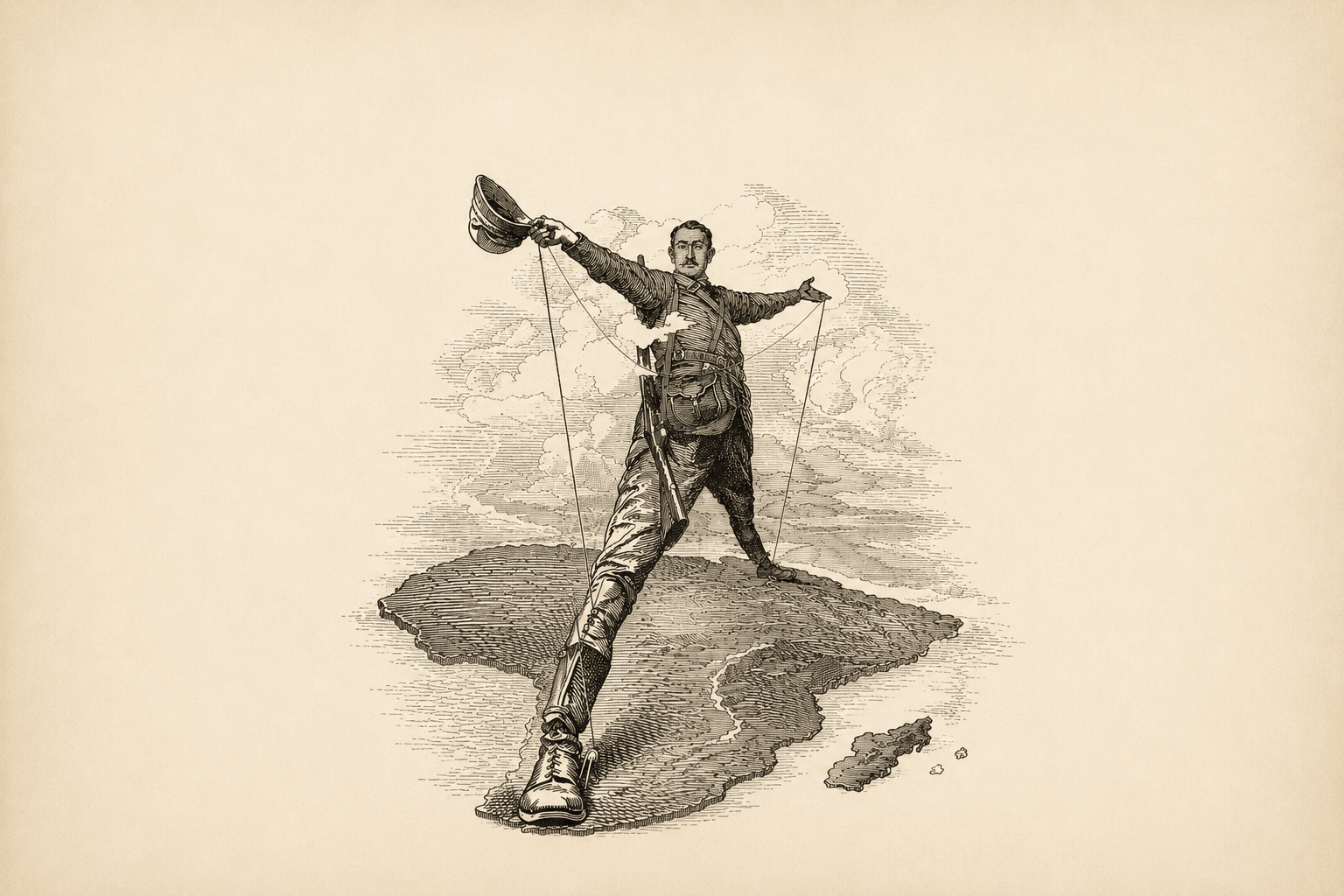
Cecil Rhodes straddling Africa
Cecil Rhodes straddling Africa. No commercial interests there.

By Dr Neel Burton — Psychiatrist, philosopher, and wine writer; Fellow of Green Templeton College, University of Oxford; author of over twenty books.

Essay substantially revised on 28 August 2026.

After the Indian Ocean tsunami of 2004, Western trauma specialists descended upon Sri Lanka expecting an epidemic of post-traumatic stress disorder (PTSD). They barely found any. The suffering, though very real, took other forms.

Until fairly recently, depression was mostly unknown to the lay population of Japan. But between 1999 and 2008, diagnoses of depression more than doubled as psychiatrists and pharmaceutical companies urged people to reinterpret their distress in terms of the disorder.

When I was growing up in Switzerland, virtually in the shadow of the World Health Organisation headquarters, I did not know anyone with ADHD, an eating disorder, or a problem with self-harm. Maybe my parents and teachers sheltered me from these things. But I watched a fair amount of television, and no one seemed to talk about them there either. So either I was living in the Truman Show, or they were much less prevalent.

Have these constructs always been there, waiting to be recognised? Then how come Aristotle, who studied everything and wrote a mountain of books, never described them? Or Hippocrates, for that matter. Or do the forms of our distress change with our interpretations of them?

Culture-Bound Syndromes and What They Reveal

Culture-bound syndromes are mental disturbances that only find expression in certain cultures or ethnic groups. There are a great many of them. For instance, dhat, seen in South Asian men, involves sudden fear about loss of semen in the urine, whitish discolouration of the urine, and sexual dysfunction, accompanied by feelings of weakness and exhaustion. Dhat may be rooted in the old Ayurvedic conception of semen as the most refined and precious of the bodily substances, reflected in the Eastern belief that it takes forty drops of blood to create a drop of bone marrow, and forty drops of bone marrow to create a drop of semen, and therefore that semen is a concentrated essence of life.

Culture-bound syndromes do not sit all too comfortably in Western classifications of mental disorder. DSM-IV simply defined them as ‘recurrent, locality-specific patterns of aberrant behavior and troubling experience…’ and listed a small number of paradigmatic forms such as dhat, koro, and susto.

DSM-5, published in 2013, replaces the notion of culture-bound syndromes with three ‘cultural concepts of distress’: cultural syndromes, cultural idioms of distress, and cultural explanations for distress. Rather than merely listing specific cultural syndromes, DSM-5 adopts a broader approach to cultural issues and acknowledges that all mental disorders, including DSM disorders, can be culturally shaped.

This is an important admission. The old concept of a culture-bound syndrome assumed that other people’s disorders were culturally shaped, whereas the West’s were an objective reflection of human biology. A man in Lahore who feared losing his vital essence in his semen was culture-bound; a man in London who understood his unhappiness as a chemical imbalance in his brain was science.

Science on Export

However, some DSM disorders are, it seems, much more culturally shaped than others. Thus, PTSD, ADHD, anorexia nervosa, bulimia nervosa, depression, and deliberate self-harm among others can all be understood as cultural syndromes—not natural kinds awaiting discovery, like Aristotle’s species, but shifting expressions of human distress. Yet, for being in the DSM, they are usually seen, and largely legitimised, as biological and therefore universal expressions of human suffering.

This matters because Western psychiatry does not stay in the West—which would be bad enough. Arm in arm with pharmaceutical companies, classifications such as DSM and ICD encourage the wholesale exportation not only of Western mental disorders, but also of Western accounts and approaches to mental disorder—and, ultimately, of Western values or tropes such as biologism, individualism, and the medicalisation of distress and deviance.

Japan, with which we began, offers a striking example. The anthropologist Junko Kitanaka has documented how depression went from being a relatively obscure condition to one of the most talked-about illnesses in recent Japanese history. The important question is not simply whether the Japanese became more depressed, but what happened when depression became available as a culturally sanctioned way of understanding distress.

Perhaps the suffering had always been there, but lacked the language—or permission—to express itself in the form of depression. But there is another possibility: that, by supplying a new language and template for distress, psychiatry did not merely reveal an existing epidemic but helped to shape one—and then sell the cure. Japan, coincidentally, happened to be rich.

A diagnosis, on this account, does not merely name something that already exists. Once established in a culture, it can influence which aspects of distress are noticed, how they are interpreted and expressed, and what is done about them. It becomes available not merely to psychiatrists but also to the people who suffer, who may be eager for an explanation of their suffering—and for a solution.

What It’s Costing Us

In Crazy Like Us: The Globalization of the American Psyche, the journalist Ethan Watters shows how psychiatric imperialism is leading to a pandemic of Western disease categories and treatments. Watters argues that changing a culture’s ideas about mental disorder actually changes that culture’s mental disorders, depleting the store of local beliefs and customs which, in many cases, provided better answers to people’s problems than antidepressants and antipsychotics. For Watters, ‘the most devastating consequence of the spread of American culture has not been our golden arches or bomb craters but our bulldozing of the human psyche itself.’

He writes:

Looking at ourselves through the eyes of those living in places where human tragedy is still embedded in complex religious and cultural narratives, we get a glimpse of our modern selves as a deeply insecure and fearful people. We are investing our great wealth in researching and treating this disorder because we have rather suddenly lost other belief systems that once gave meaning and context to our suffering.

To me, Watters seems to be describing a vicious cycle: biologism can take hold because the psyche has become impoverished, and biologism in turn further impoverishes it. The more we medicalise our suffering, the less meaning it can have; and the less meaning it has, the more we need to medicalise it. We’re receiving the signal, but attending to the sound rather than to the message.

Templates of Distress

Distressed people tend to externalise their suffering, partly to make it more manageable, and partly so that it can be recognised and legitimised. According to the medical historian Edward Shorter, our culture’s beliefs and narratives about illness provide us with a limited number of templates or models of illness by which to externalise our distress. If authorities such as psychiatrists and celebrities appear to endorse or condone a new template such as ADHD or deliberate self-harm, the template enters into our culture’s ‘symptom pool’ and the condition starts to spread. Meanwhile, tired templates seep out of the symptom pool, which may explain why conditions such as hysteria, fugue, and catatonic schizophrenia, which were once common, have become so rare.

The number of cases of bulimia nervosa rose in 1992, the year in which the journalist Andrew Morton exposed Princess Diana’s ‘secret disease’, and peaked in 1995 after Diana went public with her eating disorder. It began to decline in 1997, the year of her tragic death. This synchronology suggests that Diana’s iconic status combined with intense press coverage of her bulimia—and bulimia in general—led to an increase in the incidence of the disorder. Something similar happened in South Korea in 2010-12, when diagnoses of panic disorder shot up after several celebrities disclosed that they suffered from the condition.

Of course, Diana may simply have encouraged people who were already suffering from bulimia to recognise it and come forward. But Shorter’s more unsettling possibility is that, by making a particular template of distress culturally available, she also made it more likely that distressed people would stumble into it.

This does not mean that people consciously choose their symptoms, still less that they are pretending. Culture operates at a much deeper level than that. Just as we do not choose the language in which we dream—or even the contents of our dreams—so we do not choose the language in which we suffer.

And this brings us back to the central paradox of psychiatric imperialism. By exporting Western psychiatric templates, we may be creating the very universality that we claim merely to have discovered. And there are strong commercial drivers for doing so: universal disorders create universal markets. In exporting the diagnosis, we help to create the disease—or, on a global scale, an invisible pandemic.

The danger for us psychiatrists and health professionals when treating people with mental disorder is to treat the template without addressing or even acknowledging the very real distress that lies beneath—to hand out the tablets without asking what the suffering is about, and how it might actually be alleviated.

Continue Exploring

If this essay spoke to you, you might look into The Meaning of Madness.

You may also enjoy

Explore all Mental Health essays

We are being lazy if we are able to carry out some activity that we ought to carry out, but are disinclined to do so on account of the effort involved. Instead, we remain idle, carry out the activity perfunctorily, or engage in some other less strenuous or boring activity. In short, we are being lazy if our motivation to spare ourselves effort trumps our motivation to do the right or best or expected thing—assuming, of course, that we know, or think that we know, what that is.

Synonyms for laziness include indolence and sloth. Indolence derives from the Latin indolentia, ‘without pain’ or ‘without taking trouble’. Sloth has more moral and spiritual overtones than either laziness or indolence. In the Christian tradition, sloth is one of the seven deadly sins (the other six being lust, gluttony, greed, wrath, envy, and pride) because it undermines society and God’s plan and invites all manner of sin. The Bible inveighs against slothfulness, notably in the Book of Ecclesiastes: ‘By much slothfulness the building decayeth; and through idleness of the hands the house droppeth through. A feast is made for laughter, and wine maketh merry: but money answereth all things.’

Laziness should not be confused with either procrastination or idleness. To procrastinate—from the Latin cras, ‘tomorrow’—is to postpone one task in favour of another or others which are perceived as being easier or more pleasurable but which are typically less important or urgent. To postpone a task for constructive or strategic purposes does not amount to procrastination. For a postponement to amount to procrastination, it has to represent poor or ineffective planning and result in a higher overall cost to the procrastinator, for example, in the form of stress, guilt, lost productivity, or lost opportunities. It is one thing to delay a tax return until all the numbers are in, but quite another to delay it so that it upsets our holiday plans and lands us with a fine. Both the lazybones and the procrastinator lack motivation, but unlike the lazybones the procrastinator aspires and intends to complete the task under consideration, and, moreover, eventually does complete it, albeit at a higher cost to himself.

To be idle is, not to be doing anything. Idleness is often romanticized, as epitomized by the Italian expression dolce far niente (‘it is sweet to do nothing’). Many people tell themselves that they work hard from a desire for idleness. But although our natural instinct is for idleness, most of us find prolonged idleness difficult to bear. Queuing for half an hour in a traffic jam can leave us feeling bored, restless, and irritable, and many motorists prefer to make a detour even if the alternative route is likely to take longer than sitting through the traffic. Recent research suggests that people will find the flimsiest excuse to keep busy, and that they feel happier for keeping busy even when their busyness is imposed upon them. In their research paper (Hsee CK et al. (2010), Idleness aversion and the need for justifiable busyness. Psychological Science 21(7): 926–930.), Christopher Hsee and his colleagues surmise that many of our purported goals may be little more than justifications for keeping busy.

We could be idle because we have nothing to do—or rather, because we lack the imagination to think of something to do. If we do evidently have something to do, we could be idle because we are lazy, but also because we are unable to do that thing, or because we have already done it and are resting and recuperating. Lastly, we could be idle because we value idleness or its products above whatever it is we have to do, which is not the same thing as being lazy. Lord Melbourne, Queen Victoria’s favourite prime minister, extolled the virtues of ‘masterful inactivity’. As chairman and CEO of General Electric, Jack Welch spent an hour each day in what he called ‘looking out of the window time’. Adepts of such strategic idleness use their ‘idle’ moments, among others, to gather inspiration, develop and maintain perspective, sidestep nonsense and pettiness, reduce inefficiency and half-living, and conserve health and stamina for truly important tasks and problems. ‘To do nothing at all,’ said Oscar Wilde, ‘is the most difficult thing in the world, the most difficult and the most intellectual.’

Adapted from Heaven and Hell: The Psychology of the Emotions.

The Psychology and Philosophy of Pity, Sympathy, Empathy, and Compassion

A doctor or nurse empathizing with a patient
Empathy begins with the simple but profound attempt to see the world through another person’s eyes.

By Dr Neel Burton — Psychiatrist, philosopher, and wine writer; Fellow of Green Templeton College, University of Oxford; author of over twenty books.

Essay substantially revised on 22 July 2026.

Article summary: Empathy and sympathy are often confused, but they are not the same. This article explores the psychology and philosophy of pity, sympathy, empathy, and compassion, explaining how they differ, why they matter, and what they reveal about human nature.

The terms empathy and sympathy are often used interchangeably, but they are not the same. Sympathy is care or concern for another person’s suffering. Empathy goes a step further: it involves understanding and, to some extent, sharing in that person’s emotional experience. Compassion, which involves the desire to relieve suffering, builds upon empathy. These distinctions matter—not only in psychology and medicine, but also in friendship, parenting, education, and everyday life.

Suppose a friend has just lost a parent. If I say, ‘I’m so sorry this has happened to you,’ I’m expressing sympathy. If I can also imagine, however imperfectly, what this loss feels like from within their own world, I begin to empathise. If that empathy inspires me to support them through their grief, it becomes compassion.

Before examining these concepts, it is worth asking where the modern idea of empathy came from.

What Is Empathy?

In 1909, the psychologist Edward Titchener translated the German Einfühlung (‘feeling into’) as empathy. At that time, German philosophers discussed empathy in the context of artistic or aesthetic evaluation, but Titchener proposed that empathy can also help us to recognise one another as minded beings.

Today, empathy might be defined as a person’s ability to understand and, to a greater or lesser extent, share in the emotions of another person, fictional character, or sentient being. Empathy involves two closely related capacities: (1) seeing another person’s situation from their embodied perspective, and (2) resonating with, or sharing in, the emotions that they are feeling.

For me to share another person’s point of view, it is not enough merely to put myself into their position or situation. Instead, I must go further still and imagine myself as them, and, more than that, imagine myself as them in the situation in which they find themself. One cannot empathise with an abstract or detached feeling, only with a particular person. To empathise with them, I need to have some understanding of who they are and what they are doing, or trying to do. I need to have some idea of where they came from and where they want to go. As John Steinbeck famously wrote:

It means very little to know that a million Chinese are starving unless you know one Chinese who is starving.

Pity, Sympathy, Empathy, and Compassion

Empathy is easily confused with pity, sympathy, and compassion, which are all prosocial reactions to the plights of others. Let us look at each one in turn.

Pity is a feeling of discomfort at the distress of one or more sentient beings and usually carries paternalistic overtones. Inherent in the notion of pity is that its object does not deserve its plight, and is incapable of preventing or overturning it. Pity is less engaged than sympathy, empathy, or compassion, often amounting to little more than a conscious acknowledgement of another’s suffering.

Sympathy (Greek, ‘fellow feeling’ or ‘community of feeling’) is care or concern for someone, often someone close or relatable, accompanied by a wish to see them better off. Compared with pity, sympathy implies a greater sense of shared similarities and deeper personal engagement. But unlike empathy, sympathy need not involve a shared perspective or shared emotions, and while the facial expressions of sympathy convey caring and concern, they do not ordinarily convey shared distress.

Sympathy and empathy often lead to one another, but not invariably. For instance, it is possible to sympathise with a hedgehog but not, strictly speaking, to empathise with it, since our access to its subjective experience is necessarily limited. Conversely, psychopaths with little or no sympathy for their victims may nonetheless possess sufficient understanding of another person’s thoughts and motivations to ensnare and manipulate them.

Sympathy might also be distinguished from benevolence, which is a more detached and impersonal attitude—akin to the attitude that I might have towards my students or neighbours, or that a monarch might have towards his or her subjects.

Compassion (Latin, ‘suffering alongside’) is more engaged than empathy and is associated with an active desire to alleviate the suffering of its object. With empathy, I share your emotions; with compassion I not only share your emotions but also elevate them into a universal and transcending experience. Compassion, which builds upon empathy, is one of the principal motivators of altruism.

Researcher Brené Brown has done much to popularise the distinction between sympathy and empathy, arguing that sympathy creates distance while empathy creates connection. Her work has helped bring empathy to a much wider audience. Even so, sympathy need not be distant or dismissive. Properly understood, it is often the beginning of empathy rather than its opposite.

The relationship between pity, sympathy, empathy, and compassion can be summarised as follows:

Can We Ever Know Another Mind?

My friend tearfully confides that, as a child, she was sexually abused by her father. Moved by her plight, I try to comfort her:

‘I know just how you feel.’

To my surprise and alarm, she snaps back:

‘No, you don’t know how I feel! How could you?’

Notice that, in claiming that I cannot know how she feels, my friend is implying that she knows how I feel—or, at least, that however I might be feeling, it is not how she feels. But if she is correct in asserting that I cannot know how she feels, how can she know how I feel, or that how I feel is not how she feels?

A similar paradox is raised in the Zhuangzi (c. third century BCE), one of the two foundational texts of Taoism:

Zhuangzi and Hui Shi were strolling on the bridge above the Hao River. Zhuangzi said, ‘Out swim the minnows so free and easy; this is the happiness of fish.’ Hui Shi said, ‘You are not a fish. Whence do you know the happiness of fish?’ Zhuangzi said, ‘You are not me. Whence do you know I don’t know the happiness of fish?’ Hui Shi said, ‘Granted that I am not you, I don’t know about you. Then granted that you are not a fish, the case for your not knowing the happiness of fish is complete.’ Zhuangzi said, ‘Let’s trace back to the root of the issue. When you said, ‘Whence do you know the fish are happy?’, you asked me already knowing I knew it. I knew it from up above the Hao.’

The exchange captures an enduring philosophical puzzle. We can never inhabit another person’s consciousness. Yet, in everyday life, we routinely understand enough of one another’s inner worlds to communicate, cooperate, comfort, teach, love, and forgive. How is this possible?

Theory of Mind and Mirror Neurons

Empathy rests upon what psychologists call theory of mind: the ability to understand that different people see the world from different perspectives and possess different beliefs, desires, sensitivities, commitments, and forms of understanding.

Some writers distinguish between cognitive empathy and affective empathy. From a philosophical point of view, however, it is preferable to distinguish theory of mind from empathy, rather than to divide empathy into ‘cognitive’ and ‘affective’ forms, thereby obscuring the distinct role of theory of mind. On this view, theory of mind forms the cognitive basis for empathy, while empathy itself also involves emotional resonance.

Theory of mind is innate (‘from up above the Hao’), first appearing at about four years of age. Thereafter, it continues to develop, and can be trained in both reach and accuracy. Crucially, theory of mind enables us to posit the intentions of others and to explain and predict their actions.

Researchers have proposed that mirror neurons contribute to this capacity. These neurons fire both when we carry out a particular action and when we witness that same action in someone else. By internally modelling the actions of others, they may help us infer some of the thoughts, emotions, and desires that gave rise to them. Although empathy and theory of mind involve a broader network of cognitive processes, mirror neurons offer one suggestive illustration of how we may come to understand the experiences of others.

Why Did Empathy Evolve?

From an evolutionary standpoint, empathy has been selected for because it promotes parental care, prosocial behaviour, and non-verbal communication, and, by extension, the survival of the proximal gene pool. By supporting social interaction, collective enterprise, resource sharing, teaching and learning, and storytelling and other art forms, empathy increases the strength, stability, and resilience of a society and its members.

Empathy enables us to anticipate the actions and reactions of others and to respond effectively to their ever-changing needs and expectations. At the same time, to empathise is not to merge. Because empathy remains at one remove, it provides a degree of distance in which to make normative judgements about the person or people being empathised with and to weigh up their best interests.

The Limits of Empathy

That said, empathy can also skew our judgement, leading us to violate moral principles to favour the one or the few over the many. It can be distressing or exhausting. Doctors and nurses who are surrounded by human suffering often constrain or regulate their empathetic faculty, not out of callousness or unconcern but to guard against compassion fatigue and burnout.

Yet in less pressured environments, the exercise of empathy is often rewarding and even revitalising. Doctors and nurses who are able to empathise with their patients—though not so much that it prevents them from resting and recuperating—are more likely to feel fulfilled in their work, to say nothing of the benefit to the patients themselves.

Empathy does not grant direct access to another person’s inner world. Rather, it is our best means of approaching that world while respecting its separateness. It allows us to understand without possessing, to care without collapsing distinctions, and to recognise that every human being lives a life that is uniquely their own.

Continue Exploring

If this essay spoke to you, you might look into Heaven and Hell: The Psychology of the Emotions.

You may also enjoy